
The content strategy for SMEs It begins by pausing, organizing, and deciding. When everything seems confusing, the first step is not to create more content, but to clarify objectives, target audience, and the real role of communication in the business.
If you work for a small or medium-sized business, it's likely that your digital communication has grown gradually, without a clear strategic plan. There are social media posts, a website, and sometimes even a closer look at SEO, but everything functions in a somewhat uncoordinated way.
In practice, this is common in the SMEs I work with. There is effort and intention. What is missing is a strategic structure that connects content, business, website, and digital channels in a coherent system.
Content strategy is not the creation of an editorial calendar. It is a decision-making process that answers questions such as:
- To whom is the company specifically communicating?
- What does the content need to do for the business?
- What role do the website, SEO, and social media play in this strategy?
When these answers are not clear, the content becomes an exercise in trial and error. This is where many companies fail, even when they follow best practices, as promoted by entities like Google Search Central.
Throughout this article, I explain where to start when there is no content strategy, with real examples from small and medium-sized enterprises, common mistakes, and practical learnings.
If you feel that your company's communication needs structure before more content, talk to me. The first step is to align a content and context strategy before executing.

Why does SME communication become confusing?
The confusion in SME communication rarely arises from a lack of effort. It arises because decisions are made in isolation, at different times, without a global vision that unites them.
I've seen this, for example, in a consulting firm that started by creating social media because "everyone was there." Later, they launched a website, often thot of merely as a business card. Only at a later stage did the investment in SEO emerge, without reviewing messages, structure, or priorities. SEO, sem rever mensagens, estrutura ou prioridades.
In these cases, the result is usually this:
- content on social media that is not linked to the website
- a site that doesn't answer the real questions of those who search
- SEO treated as technical optimization, not as part of the strategy
None of this is problematic in isolation. The problem arises when everything coexists without hierarchy.
Communication becomes confusing when:
- each channel responds to a different objective
- there is no central message
- the decisions are reactive and not strategic
When I see this scenario in an SME, the work does not start with new content. It starts by reorganizing what already exists and deciding what makes sense to keep, adjust, or abandon.
This type of confusion is common in small and medium-sized enterprises and is not a sign of incompetence. It is a sign of growth without structure.
If you recognize this scenario in your company's communication, talk to me. The first step is to structure before producing. fale comigo. O primeiro passo é estruturar antes de produzir.
What is a content strategy (and what it is not)
A content strategy exists to provide direction. It is not meant to speed up production, it is meant to guide decisions before any execution.
Simply put, content strategy is the process that defines:
- what to communicate
- to whom to communicate
- with what purpose
- and thru which channels
Por esse motivoThat's why content strategy is not an editorial calendar. The calendar is a consequence. The strategy comes first.
In contrast, a content strategy is also not:
- publishing regularly
- be present on all platforms
- follow formats or trends without context
A well-defined strategy first answers the right questions and only then moves on to topics, formats, or frequency.
Por isso, do ponto de vista pedagógico, podemos encarar a estratégia como decisão, o conteúdo como execução, o SEO como amplificação e as redes sociais Therefore, from a pedagogical point of view, we can view strategy as decision-making, content as execution, SEO as amplification, and social media as distribution. If this hierarchy does not exist, the communication effort becomes scattered. When it exists, each piece of content begins to fulfill a clear role in the system.
It is also at this point that many companies get confused when approaching SEO for businesses. Without strategy, SEO becomes a set of technical optimizations disconnected from the business. With strategy, it is a tool to reinforce visibility, authority, and coherence over time.
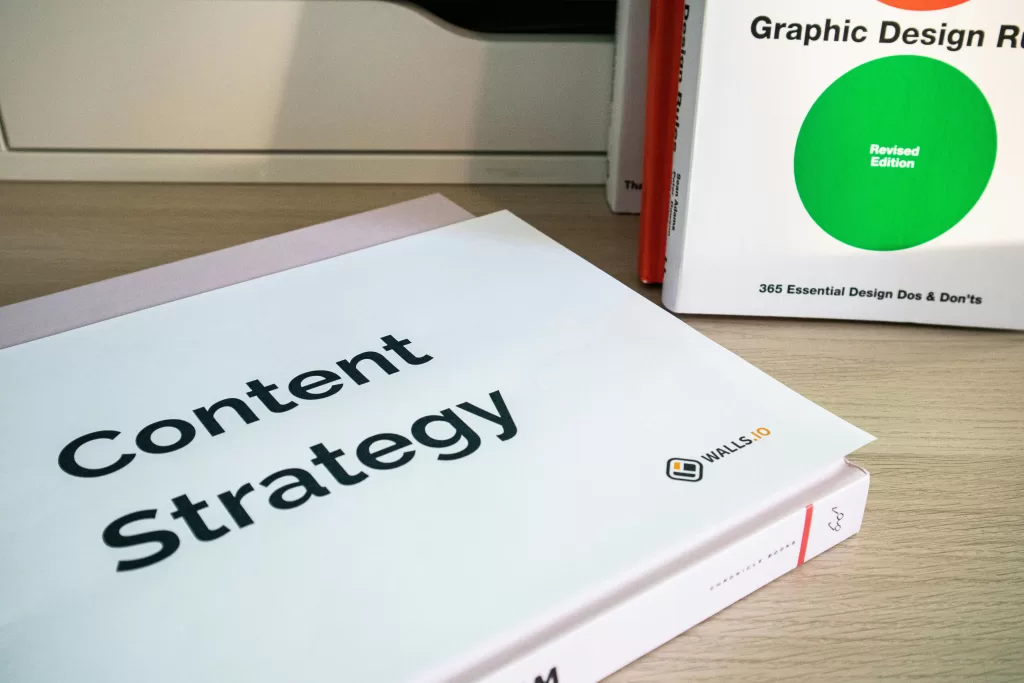
Where to start when there is no content strategy
Quando não existe uma content strategy,When there is no content strategy, the temptation is to start producing to "not be idle". In practice, this only accelerates the confusion. The right starting point is different.
Before thinking about themes, formats, or frequency, it is necessary to create a minimum decision base. It is this foundation that separates strategic communication from reactive production.
Start with the business, not the content
The first step is to clarify what the company needs to achieve with communication. Not in vague terms, but in business terms.
Some real examples:
- a healthcare company needs, above all, to build trust construir confiança
- a B2B service company needs to educate before selling educar antes de vender
- uma empresa local precisa de atrair procura qualificada, não apenas visibilidade online
Understand for whom you are communicating, in a concrete way
After the deal, comes the audience. Not the idealized audience, but the real audience. Many companies say they communicate "to businesses" or "to everyone." In practice, this translates into generic and ineffective messages.
When this definition is well made:
- the tone adjusts
- the themes become clearer
- the content stops trying to please everyone
I often see technical companies communicating as if they were speaking to laypeople, or service companies using overly vague language to avoid excluding anyone. The effect is the opposite of what was intended.
Define the role of content in the digital strategy
Not all content has to sell, but all content must serve a purpose. The content can serve to:
- attract qualified traffic
- strengthen authority
- support contact decisions
- sustain SEO over time
It is in it that the content is organized, gains context, and builds coherence, especially when there is a focus on improving the site's SEO. When this logic is absent, I see companies investing in SEO without clear returns. When it exists, the content begins to function as a strategic asset. melhorar o SEO do site. Quando esta lógica não existe, vejo empresas a investir em SEO sem retorno claro. Quando existe, o conteúdo passa a funcionar como ativo estratégico.
When content, site, and SEO are not aligned, the investment loses impact. It is precisely in this alignment that I work.
Choose few channels and use them with intention
Finally, it is necessary to decide where to communicate. Not where "everyone is," but where it makes sense to be. An effective content strategy prioritizes:
- few channels
- consistent messages
- conscious decisions
4 common mistakes when trying to "organize" the content strategy
When a company realizes that its communication is confusing, the most common reaction is to try to "fix" it quickly. The problem is that, often, this organization happens in the wrong places. These are the mistakes I encounter most frequently when working with small and medium-sized enterprises.
1. Start with the editorial calendar
Creating a calendar gives a false sense of control. Without strategy, the calendar merely organizes content that doesn't know its purpose. I see companies defining frequency, sections, and formats without ever having decided:
- what objective each piece of content should fulfill
- what role it has on the site
- how it connects to the rest of the communication
The calendar should be the last step, not the first.
2. Copy what other companies do
This error is particularly common when communication is reactive. The company looks at competitors or references and tries to replicate formats, themes, or presence on channels. The problem is simple:
- the contexts are different
- the publics are different
- the goals are different
What works for another company may be irrelevant or even harmful to yours. Therefore, inspiration without adaptation is not strategy.
3.Treating SEO as an isolated solution
This mistake can be costly. Without a content strategy, SEO becomes a set of technical optimizations disconnected from the business. The site may even gain traffic, but it doesn't gain clarity, authority, or relevant contacts. That's why SEO works when there is a strategy, not when it replaces one.
If you invested in SEO and don't see a real impact on the business, send me a message. Because here, the problem is rarely technical. envie-me uma mensagem. Porque aqui, o problema raramente é técnico.
4. Produce more instead of thinking better
When the results don't appear, the easiest response is usually to turn up the volume. More posts, more articles, more effort. In practice, this only amplifies the confusion that already exists. Clarity and impact are achieved thru coherence and content aligned with objectives.
The true gain of a well-thought-out content strategy
The greatest benefit of a content strategy is not producing more or publishing more frequently. It's gaining clarity. When there is strategy, decisions become simpler:
- know what to communicate and what to ignore
- each piece of content has a defined role
- the website, SEO, and social media stop competing with each other
I see companies completely changing the way they communicate when they stop reacting to external stimuli and start making decisions based on clear objectives. Content ceases to be a constant effort and becomes an asset that works over time.
A well-thought-out strategy allows:
- consistent communication
- better use of resources
- building trust in the market
- sustained growth, not episodic
This is a job that is not done once. It requires monitoring, review, and the ability to adapt, always without losing the strategic thread.
If you want to structure your company's communication with a long-term vision and stop reacting without criteria, talk to me. The first step is to talk about strategy. fale comigo. O primeiro passo é conversarmos sobre estratégia.

